Hanna Schmitz's suicide
The ReaderHanna Schmitz’s suicide is the abrupt ending of her anticipated release after eighteen years in prison. She dies at daybreak on the morning after Michael Berg visits her and just before he is due to collect her; she leaves no explanation. The death converts the warden’s practical preparations for a return to ordinary life into an unanswered question, while Michael’s later account places it within a longer reckoning with love, concealment, anger, and guilt.
Background: Contact and the prospect of release
After his separation from Gertrud, Michael begins recording books for Hanna. He does not make the recordings a personal conversation: he reads the title, author, and text, then stops the machine. The first package reaches her in the eighth year of her imprisonment, and he continues sending tapes until the eighteenth, the year her appeal for clemency is granted. Their contact is therefore sustained but deliberately narrow, made up of reading rather than visits or personal exchange.
In the fourth year of this word-driven but wordless connection, Hanna sends a brief handwritten note thanking him for a story. Michael recognizes from the note that she has learned to write and feels joy and pride at her movement from dependence toward independence. The exchange deepens their connection, but it does not remove the distance he has maintained: he never asks after her on the tapes or tells her about his own life. Her suicide follows years of correspondence in which the recordings and short notes have been their only contact with the outside world described here.
As release approaches, the prison warden writes to Michael because she understands him to be Hanna’s long-term correspondent and her only outside contact. She expects the parole board to grant Hanna’s next appeal and asks him to help arrange a small apartment and work, visit her, and support her adjustment to life beyond prison. The warden stresses that ordinary tasks—shopping, dealing with authorities, or going to a restaurant—can be difficult after eighteen years inside, and that a companion can make the transition easier. She also notes that Hanna is in excellent health and has worked skillfully in the sewing shop. Release is presented not as an effortless homecoming but as a demanding passage for which practical and social support matter.
Death and the unanswered question
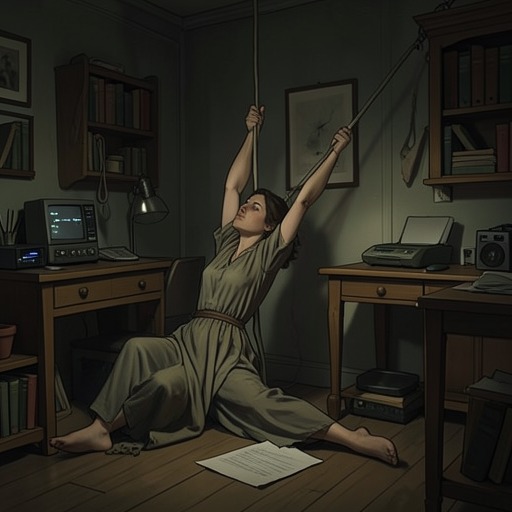
The morning after Michael’s final visit, Hanna is dead: she has hanged herself at daybreak. The stark announcement provides the fact of her death but no motive. When the warden asks whether Michael noticed anything in their recent telephone conversation or meeting that made him fear for Hanna, he says he had no suspicions or fears that he had ignored. The account does not establish that he could have foreseen or prevented her suicide.
The warden confirms that Hanna left no explanation for her decision. She also refuses to disclose what passed between herself and Michael that might have led Hanna to kill herself on the night before he was due to pick her up. Her question keeps the relationship’s final encounter unresolved: the narrative supplies neither a confession nor a definitive causal account. The timing makes the impending release inseparable from the death, but it does not prove that release itself, or any particular exchange with Michael, caused it.
Prison life and the cell
After Hanna’s death, the warden takes Michael to see the cell as Hanna left it. She explains that Hanna did not pack. The small room contains a bed, closet, table, chair, shelf, sink, and toilet; books, an alarm clock, a stuffed bear, mugs, instant coffee, tea tins, Michael’s cassette machine, and the tapes he made remain there. The objects register the ordinary arrangements of her prison life and make the recordings physically present at the scene of her absence.
The warden recalls a change in Hanna’s manner of living. For years, Hanna treated prison almost like a voluntary retreat: she worked, kept herself meticulously clean, and was respected by the other women, who sought her advice. Her authority extended to disputes; when she intervened, her decision was accepted. A few years before her death, however, she began to withdraw further. She ate more, washed less, and sought a more isolated existence in which appearance and other people’s attention mattered less. The warden cautions against simply describing this as surrender: Hanna had redefined her place in prison, though the change no longer impressed the other women. This account supplies a history of withdrawal, not an explicit explanation of the suicide.
The final encounter and aftermath
When Michael sees Hanna’s body in the infirmary, the warden draws back the sheet. He first sees the face as rigid and dead; as he continues looking, he perceives the young face within the old one. The recognition arrives too late to alter their last meeting. He wonders why he had not seen this reflection a week earlier, making the scene not a resolution between them but a belated recognition of the woman whose voice, in his memory, had remained young.
Hanna’s will directs the remaining money in a lavender tea tin, together with 7,000 marks in the bank, to the daughter who survived the church fire with her mother. Hanna asks that the recipient decide what to do with the money and that Michael be told she says hello. The message is not a personal farewell to him. Michael wonders whether Hanna meant to hurt or punish him, or whether exhaustion had narrowed what she could write to what was absolutely necessary; the text leaves these possibilities open. The money and greeting instead turn her final instructions outward, toward a survivor of the fire and a decision the recipient is free to make.
Significance in Michael’s retrospective account
Years after Hanna’s death, Michael says that he was tormented by questions about whether he had denied or betrayed her, whether he owed her something, whether loving her made him guilty, and whether he was responsible for her death. He also describes anger at Hanna and at what she had done to him. Eventually the anger faded and the questions ceased to determine how he understood his life. His conclusion is not that the past has been settled or that the suicide has become intelligible: whatever either of them did, their actions became the path his life took.
The death’s narrative force lies partly in what remains unknown. The warden asks Michael for an account of their final relationship, but he cannot speak freely; he is overwhelmed by grief and does not want to cry in front of her. Neither Hanna’s will nor the warden’s recollections explain why she died. The novel consequently distinguishes between Michael’s continuing attempt to interpret the event and evidence that would establish a cause. Her suicide ends the possibility of the practical reunion the warden had tried to arrange, while leaving Michael with no final conversation that could resolve the relationship or assign responsibility with certainty.